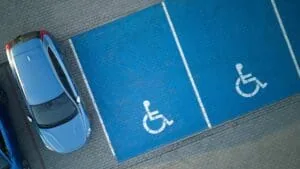
Most businesses open to the public must meet federal accessible parking requirements under the Americans with Disabilities Act (ADA). An ADA-compliant parking lot helps people with disabilities safely access and navigate your business, but compliance involves more than designating a few parking spaces or painting accessibility symbols. Space counts, dimensions, access aisles, slopes, surfaces, signs, and accessible routes all matter.
Magnum Paving provides commercial ADA-compliant parking lot paving throughout Atlanta and Georgia. We offer industry-leading asphalt paving services to help business owners, property managers, and municipalities address the physical features that comply with accessible parking. In this guide, we leverage our expertise to explain what makes a parking lot ADA-compliant, from the number of spaces to the striping and slope requirements.
What Makes a Parking Lot ADA-Compliant?
Keeping a parking lot ADA-compliant depends on a facility’s size and type. Business owners should generally pay close attention to five key areas.
The Five Things Your Parking Lot Needs
Enough accessible parking spaces: The required number is based on the total number of spaces in each parking facility. Certain healthcare facilities have additional requirements.
Correct spaces and access aisles: Accessible spaces need properly sized access aisles so people using wheelchairs and other mobility devices have room to enter and exit their vehicles.
Proper surface and slope: Accessible parking spaces and access aisles must have firm, stable, slip-resistant surfaces. Slopes cannot be steeper than 1:48, or approximately 2.08%, in any direction.
Proper signage and markings: Accessible spaces generally require vertical signs displaying the International Symbol of Accessibility. Van-accessible spaces need an additional “van accessible” designation. Access aisles must also be marked to discourage parking, while state and local rules may establish additional marking requirements.
An accessible route to the building: Access aisles must connect to an accessible route leading to an accessible entrance. A correctly sized parking space alone does not provide accessibility if a person cannot safely travel from the space to the building.
Who Does ADA Apply To?
Title III of the ADA applies to businesses and nonprofit organizations that are open to the public, including many restaurants, stores, healthcare providers, and other commercial facilities. New construction and alterations must follow applicable ADA Standards for Accessible Design.
How Many ADA Spaces Does Your Parking Lot Require?
The number of accessible spaces depends on the total number of spaces in each parking facility. If a property has multiple parking facilities, you generally calculate the required number separately for each facility rather than combining every space on the property.
The minimum requirements are:
|
Total Parking Spaces in Lot |
Minimum Required Accessible Spaces |
|---|---|
|
1–25 |
1 |
|
26–50 |
2 |
|
51–75 |
3 |
|
76–100 |
4 |
|
101–150 |
5 |
|
151–200 |
6 |
|
201–300 |
7 |
|
301–400 |
8 |
|
401–500 |
9 |
|
501–1,000 |
2% of total |
|
1,001+ |
20 + 1 per 100 over 1,000 |
Van-Accessible Space Requirements
At least one of every six accessible spaces, or a fraction of six, must be van accessible. When a parking facility requires only one accessible space, that space must be van accessible.
Van-accessible parking can use either of two configurations:
-
An 11-foot-wide parking space with a minimum 5-foot access aisle
-
An 8-foot-wide parking space with a minimum 8-foot access aisle
Van-accessible spaces also require at least 98 inches of vertical clearance at the parking space, access aisle, and applicable vehicular route.
Special Parking Facilities
Certain healthcare facilities also have special requirements. At least 10% of patient and visitor spaces serving hospital outpatient facilities must be accessible. Rehabilitation facilities that specialize in treating mobility-related conditions and outpatient physical therapy facilities must provide accessible spaces for at least 20% of patient and visitor parking.
ADA Parking Lot Striping, Markings and Signage
Professional ADA-compliant parking lot striping helps drivers identify accessible parking and helps property owners maintain an organized, welcoming parking layout.
What Needs to Be Marked?
An ADA-compliant parking lot may include:
-
Clearly defined accessible parking spaces
-
Marked access aisles that discourage parking
-
Vertical signs with the International Symbol of Accessibility
-
“Van Accessible” signs for designated van spaces
-
Pavement symbols or additional markings required by Georgia or local codes
Sign Placement and Height
Required accessible parking signs must display the International Symbol of Accessibility and be mounted at least 60 inches above the ground, measured to the bottom of the sign.
Keeping ADA Markings Visible
Parking lot markings can fade from traffic, weather, and normal wear. Property owners should inspect accessible spaces after pavement maintenance and restripe areas as needed to keep their parking layout clear.
Surface and Paving Requirements for ADA Parking
Accessible parking spaces and access aisles must have firm, stable, and slip-resistant surfaces. They must also have slopes no steeper than 1:48, or approximately 2.08%, in any direction. If grading or deterioration prevents an accessible area from meeting these requirements, parking lot resurfacing and repair may be needed to correct the pavement.
What Makes the Surface Accessible?
Asphalt and concrete can provide firm, stable surfaces when properly installed and maintained. Loose or shifting materials can make wheelchair and mobility-device use more difficult.
Can a Gravel Parking Lot Be ADA-Compliant?
A gravel lot is not automatically compliant or noncompliant based only on the material. Accessible spaces, access aisles, and accessible routes must meet the ADA requirements for firm, stable, slip-resistant surfaces. Loose gravel that shifts under wheels or foot traffic may not meet those standards, making paved accessible areas necessary.
How Repairs, Resurfacing and Sealcoating Affect Compliance
Potholes, settlement, uneven pavement, and other deterioration can interfere with accessible routes and parking areas. Parking lot patching and pothole repair can address localized deterioration, while larger grading or surface problems may require resurfacing.
On the other hand, parking lot sealcoating can cover up existing pavement markings. Accessible parking markings should be restored as needed after routine pavement work.
Common ADA Parking Lot Problems Business Owners Should Fix
-
Accessible spaces are poorly located: Spaces should connect to an accessible route leading to an accessible entrance.
-
Spaces or access aisles have excessive slope: Accessible spaces and aisles cannot exceed a 1:48 slope, or approximately 2.08%, in any direction.
-
Access aisles are blocked or poorly marked: These areas provide room for people using mobility devices to enter and exit vehicles and should remain clear.
-
Signs or markings are missing or faded: Required signs must remain visible and properly positioned. Applicable pavement markings should also remain clear.
-
Pavement deterioration affects accessibility: Potholes, settlement, uneven transitions, and other surface problems can make accessible areas difficult to use.
-
Recent pavement work covered markings: Resurfacing, sealcoating, or repairs may require follow-up striping to restore the accessible parking layout.
Keep Your Georgia Parking Lot Accessible
ADA-compliant parking lots involve much more than striping. Pavement condition, slopes, access aisles, signs, accessible routes, and ongoing maintenance can all affect how well your parking lot serves customers and visitors.
Magnum Paving helps commercial property owners throughout Atlanta and Georgia maintain safer, more accessible parking areas with professional paving, repairs, striping, and related pavement improvements. Contact us today to get started.
ADA-Compliance FAQ
How many ADA parking spaces are required for a 100-space parking lot?
A 100-space parking facility requires at least four accessible spaces under the standard ADA table. At least one must be van accessible.
Can a gravel parking lot be ADA compliant?
Potentially, but accessible areas must have firm, stable, and slip-resistant surfaces. Loose or shifting gravel may not meet these requirements.
What is the maximum slope allowed for ADA parking spaces?
Accessible parking spaces and access aisles cannot have slopes steeper than 1:48, or approximately 2.08%, in any direction.
Does sealcoating a parking lot affect ADA compliance?
Sealcoating can cover existing pavement markings. Accessible parking markings should be restored as required before the affected parking layout returns to normal use.
What is the difference between an accessible space and a van-accessible space?
A standard accessible space is at least 8 feet wide with a 5-foot access aisle. A van space can be 11 feet wide with a 5-foot aisle or 8 feet wide with an 8-foot aisle and requires at least 98 inches of vertical clearance.